
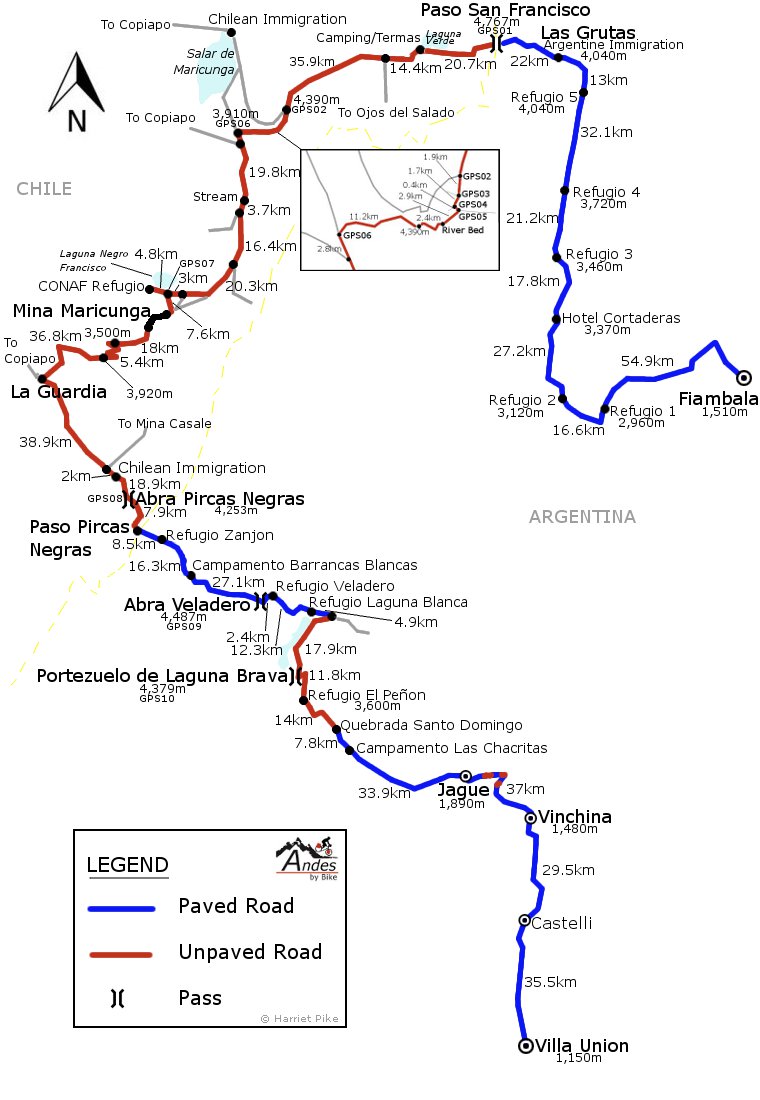
Fiambala – Paso San Francisco – PN Tres Cruces – Lag. Negro Francisco – Paso Pircas Negras – Villa Union
If long, challenging trips through beautiful but inhospitable landscapes are your kind of thing, then this high altitude loop on the Puna is hard to beat. Fiambala is a gem of a town, a great place to relax, and where even holidaying Argentines are surprised by how tranquilo the pace of life is. The draw of this place makes it difficult to leave, but on dragging yourself away make sure you stock up on supplies – the next shop is 650kms away.
In this time you’ll pedal by the biggest volcanoes in the world, freewheel down from high passes and skirt round the shores of spectacular lakes, but human settlements are few and far between. In summer you’ll still come across people – usually in Toyota Hiluxes, but also at the border posts, a couple of mines, some refugios and at La Guardia (population < 10 and the only permanent settlement on this stretch).
At other times of the year it is not possible to cycle this route legally as Paso Pircas Negras is closed. Unlike Paso San Francisco which (weather dependent) is open all year, Chilean immigration at Pircas Negras is only open Thursday-Sunday in January and February.
Although it is only about 12 cycling days from Fiambala to Villa Union, the trip is likely to take longer due to the weather, sorting out Chilean passport stamps, or simply because you want to take a few days off your bike to go and climb one of the many mountains in the area.
Chilean immigration for Paso San Francisco is at Maricunga, 110kms from the pass, which is a detour from the loop described here of about a day irrespective of whether you cycle it or try and catch a lift. (In hindsight, it’s probably best not to take the shortcut we describe here – it’d be easier to stay on the main route towards Maricunga until you hit the larger road that heads south for Laguna Negro Francisco – this would make your hitch, or riding, detour to Maricunga shorter). Rather than complete this loop, it is more common to cycle from Fiambala to Copiapo over Paso San Francisco. The first part of this route is described on this page, and the second part is at the Copiapo to Maricunga route description.
Coming from Fiambala, it takes at least a week to get to Chilean immigration at Pircas Negras. If your timings haven’t gone to plan (which is quite likely as the Puna is a very windy region, so the distance you cycle each day is often not especially within your control) and you arrive Monday-Wednesday, you’ll have to wait around with the Carabineros until the immigration police turn up on Thursday to stamp you out of the country. If you are going in the opposite direction it can be very difficult to get the Gendarmeria at the Argentine immigration post in Vinchina to stamp you out of the country Monday-Wednesday, though you may be able to so long as you can convince them that you will arrive at the Chilean Pircas Negras immigration post between Thursday and Sunday.
Though all food must be brought from Fiambala (or Vinchina/Villa Union if cycling the route in reverse) it is not necessary to carry more than 2 days’ worth of water at any one time – we’ve indicated in the route description where it can be found.
If you are cycling from Villa Union/Vinchina to Copiapo over Paso Pircas Negras good information can be found on Fiona Grant’s information page on masterlyinactivity.com. This will provide you with route information from La Guardia to Copiapo, as well as giving you another take on cycling the La Guardia – Vinchina section of the road.
As with all high altitude routes in the Andes which don’t have much traffic make sure you have sufficient kit of sufficient quality to survive a period of bad weather.
| Total dist. | Stage dist. | Description |
| 0km | Fiambala (1,510m). Tranquil place with ATM, good accommodation and restaurants, mini-markets, ice cream parlours and slow internet. Jonson Reynoso can be found in the information office on the corner of the main square. He knows the Puna better than just about anyone, and his daughter runs a good hostel. | |
| 182.8km | Climb (wind dependent) on tarmac to Argentine immigration at Las Grutas. Emergency refugios (unmanned and with no facilities) on the way make good places to spend the night if the wind is howling. Refugio 1 (2,960m) is 54.9kms from Fiambala; Refugio 2 (3,120m) is 16.6kms further on; Hotel Cortaderas (3,370m) is 27.2kms further on; Refugio 3 (3,460m) a further 17.8kms; Refugio 4 (3,720m) 21.2kms more; Refugio 5 (4,040m) 32.1kms further on. On the way to Refugio 1 there is often a river nearby, but it’s always a bit cloudy and the colour of clay after rain. Water at the hotel, and Refugios 3 and 4 have clear streams nearby. | |
| 182.8km | Las Grutas (4,040m). Argentine immigration and accommodation at a manned refugio. Water. A few hundred metres after Las Grutas there is a signed turn-off (L) to some termas (indoor but not very hot), 2kms away. Possible to spend the night there for free. To get to the base of Incahuasi continue on the rough track that turns R just before you reach the termas. | |
| 22.0km | Climb to Paso San Francisco (no water). Good views of Incahuasi and Volcan San Francisco (6,018m – probably the easiest 6,000er in the world, a day walk from the pass). | |
| 204.8km | Paso San Francisco (4,767m, GPS01) and Refugio 6 (unmanned and like the other 5 refugios has no facilities). The Argentina/Chile border. | |
| 20.7km | Ripio begins. Descend to the stunning Laguna Verde. Pass the Carabineros after 19.5kms (not manned year-round), then 1.2kms further to a turn-off (R) to a campsite (unmanned these days) and termas. | |
| 225.5km | Turn-off to Laguna Verde Termas (4,340m, don’t think there’s any drinking water). | |
| 50.3km | Climb to high point (4,530m) 7.8kms from termas turn-off. Then descend 6.6kms to turn-off to Ojos del Salado. About 10kms from here to the next high point (4,600m), then a further 25kms to the shortcut turnoff to Tres Cruces National Park. No water. | |
| 275.8km | Turnoff (L) to Tres Cruces National Park (4,390m, GPS02). The turn-off is onto a small, often sandy, track that is virtually unused (the Carabineros are trying to stop people using it as it bypasses the immigration complex at Maricunga), and is on a right hand bend less than 1km after the ‘Tres Cruces’ sign. (Better to continue on the main road to Maricunga to get your immigration stamp, for ~40kms, then backtrack for the main route from there to Laguna Negro Francisco). | |
| 20.5km | 1.9kms to (GPS03). About 1.7kms later go straight (GPS04) (not R on the main track that goes to a 1m high orange metal post). Then about 0.4kms further on go R at junction (GPS05). (We got a bit lost getting from GPS02 to GPS05, but from this junction the route is much easier to follow). Descend 2.9kms to a river bed. Cross dry river bed, (a few kms further down this is the Rio Lama which is the only source of water in the area, but would be a lengthy detour to go to, and not sure if it’s drinkable anyway) then climb 2.4kms to a high point (4,390m). The next 3.3kms is a steep, sandy descent to 4,100m, before a more gentle 7.9kms downhill to meet the main Maricunga/Lag. Negro Francisco road. | |
| 296.3km | Join main Maricunga – Lag. Negro Francisco road (3,910m, GPS06). Go L. Coming the other way, this junction is signposted ‘Rio Lamas 25km’). | |
| 19.8km | 2.8kms to a junction (straight to Lag. Negro Francisco, R to Copiapo). 8.7kms from here to a stream (not sure if it’s agua potable – we didn’t need to drink from any of the streams around here, and with mines around it might not be a very good idea to unless desperate). Stick to the main track at the many junctions where small mining tracks lead off to the hills. After a further 8.3kms cross another stream, which the road follows for a while. | |
| 316.1km | Cross stream. | |
| 43.4km | 3.7kms from crossing the stream go L at a fork. After this there are lots of small forks, but the roads always join up. 16.4kms from the fork you turned L at, go R at another fork. 4.3kms from this fork, reach a high point (4,280m). 7kms from the high point cross a (brown) river, and go R at a fork soon after. 9kms from river crossing get to a junction (4,160m – straight to Lag. Negro Francisco, L to Mina Maricunga). I don’t think this is the main way to get to Mina Maricunga though, so maybe best to go straight then 3kms later turn L to Mina Maricunga at the next junction. | |
| 359.5km | Junction (4,150m – GPS07). L to Mina Maricunga, straight to CONAF Refugio (4.8kms away on a pretty bad surface – the Guardaparques can give you drinking water in summer when they’re around.) | |
| 7.6km | (Turning L at Junction GPS07). In 3.3 kms the road from the shortcut from the 4,160m junction rejoins. 4.3kms later, arrive at the entrance to Mina Maricunga. | |
| 367.1km | Entrance to Mina Maricunga (4,220m). Manned all year, so you can get water. Here you’ll probably be stopped from cycling, and have to wait for a camioneta to take you and your bikes through the mine. On the way the road crosses Abra Mina Maricunga (4,561m). | |
| 367.1km | Exit Mina Maricunga (4,470m). | |
| 23.4km | Descend for 18kms to 3,500m – initially road follows a river. Then climb steeply for 5.4kms. | |
| 390.5km | Pass (3,920m). | |
| 36.8km | Pretty descent to main Copiapo-Pircas Negras road at La Guardia. | |
| 427.3km | La Guardia (2,610m). A few basic houses, but the only settlement between Fiambala and Jague. May be possible to buy bread and cheese from the inhabitants if they are around. Turn R for Copiapo or L for Paso Pircas Negras and Argentina. | |
| 40.9km | Scenic climb to Chilean immigration. By a stream (which, maybe unwisely, we drank from) most of the way, next to which are loads of great wild campsites. 38.9kms from La Guardia get to the turnoff to Mina Casale (L), but go straight on to Paso Pircas Negras. | |
| 468.2km | Chilean immigration (3,290m), water. Only open Thursdays-Sundays in January and February. Monday-Wednesday (January and February) it is manned by Carabineros who can’t stamp you out of the country but will probably let you watch their cable TV. The remainder of the year it is illegal to cross into Argentina via this route. | |
| 26.8km | Climb for 16.7kms to a gate that is open only in Jan/Feb. Then more gentle for 2.2kms to Abra Pircas Negras (4,253m, GPS08). Descend 5kms to a low point (4,030m) before climbing 2.9kms to Paso Pircas Negras. Beautiful scenery. No water. | |
| 495.0km | Paso Pircas Negras (4,170m). Chile/Argentina border. Tarmac starts. | |
| 24.8km | Descend 8.5kms to cross Arroyo El Zanjon (there is an old refugio around here somewhere, and Fiona Grant’s page suggests the arroyo (stream) is salty). 5.1kms later cross a big bridge over the Rio Salado (4,070m, salty as the name suggests). Climb 2.4kms to a high point (4,170m), then descend 5.9kms to a bridge over Arroyo Quebrada de los Baños (3,940m, and also apparently not drinkable). Climb 2.9kms to Campamento Barrancas Blancas. | |
| 519.8km | Campamento Barrancas Blancas (4,040m). Old roadworker camp. Looked lived in but no-one was around when we camped there. Running water (which we drank) in the river over the road, and you follow this for the first part of the climb to come. After leaving the river there is no water until Refugio El Peñon. | |
| 29.5km | Pass Refugio Barrancas Blancas (L of the road, and dirty) after about 1km. High point (4,420m) after 8.1kms. Then road undulates for 19kms to Abra Veladero (4,487m, GPS09). Good views of Cerro Veladero (6,436m). Descend 2.4kms to Refugio Veladero. All tarmac. | |
| 549.3km | Refugio Veladero (4,400m). No water, but welcome shelter from the wind. | |
| 46.9km | Downhill for 12.3kms to Refugio Laguna Brava (off road to R/south). Tarmac ends 4.9kms later. Turn R here, then follow road near Laguna Brava. High point (4,370m) 16.5kms from end of tarmac. 1.4kms further on is Portezuelo de Laguna Brava (4,379m, GPS10). Descend for 11.8kms to Refugio El Peñon. | |
| 596.2km | Refugio El Peñon (3,600m). Nicer than the other refugios. Water available at a pipe a few hundred metres down the road to Vinchina. | |
| 55.7km | 14kms of descent to Quebrada Santo Domingo (river – doesn’t look very tasty after rain). Tarmac starts straight after the river. 7.8kms from river reach another road workers’ camp (manned both times we passed, so water available). Fast 33.9km descent to turn-off to Jague. | |
| 651.9km | Turn-off to Jague (1,890m). First water since roadworkers’ camp (there is none at ‘Punta de Agua’ which is marked on some maps). If you don’t need water or supplies don’t bother leaving the tarmac to go to the village. | |
| 37.0km | Descend to Vinchina. About 8kms of ripio, the rest is tarmac. | |
| 688.9km | Enter Vinchina (1,480m). Go R near the beginning of town to go to the Gendarmeria (signposted) for your entry stamp. There are shops, restaurants and accommodation in this very long town. | |
| 72.3km | Head back to the main road from the Gendarmeria. 29.5kms to Castelli, then 35.5kms further to Villa Union. | |
| 761.2km | Villa Union (1,150m). Nice town with accommodation, shops, restaurants, tour agencies, ATM. |
| Details | |
| Time taken – 12 days and amount climbed – 8,960m | 17 hours: Fiambala – Las Grutas (3,050m climb). 6 hours: Las Grutas – Laguna Verde camping (780m climb, headwind). 7 hours: Laguna Verde – Turnoff to Tres Cruces NP (540m climb, headwind). 10 hours: Turnoff to Tres Cruces – Laguna Negro Francisco (750m climb). 11 hours: Laguna Negro Francisco – Chilean Pircas Negras Immigration (1,370m climb). 5 hours: Chilean Immigration – Campamento Barrancas Blancas (1,450m climb, tailwind) 3 hours: Campamento Barrancas Blancas – Refugio Veladero (580m climb) 9 hours: Refugio Veladero – Vinchina (390m climb) 4 hours: Vinchina – Villa Union (50m climb). |
| Traffic | A few vehicles an hour from Fiambala to Paso San Francisco. Roadwork traffic until turn-off to Tres Cruces NP. Nothing on shortcut to Maricunga-Laguna Negro Francisco road. A few mine vehicles an hour from there to La Guardia. A couple of vehicles a day from La Guardia to Laguna Brava, then more to Jague. Plenty after Jague. |
| When we cycled | February 2011. |
| Difficulty | 4 |
| How much we had to push on this route | 4 kms (sand) |
| GPS Point | Description | Lat/Long/Altitude |
| GPS01 | Paso San Francisco | 26.8735 S, 68.2988 W, 4,767m. |
| GPS02 | Turn L to Tres Cruces NP | 27.0458 S, 68.8921 W, 4,390m. |
| GPS03 | Junction (straight) | 27.0630 S, 68.8932 W, 4,400m. |
| GPS04 | Junction (straight) | 27.0764 S, 68.8974 W, 4,430m. |
| GPS05 | Junction (right) | 27.0786 S, 68.8957 W, 4,440m. |
| GPS06 | Join Maricunga-Lag Neg Francisco rd | ~27.1064 S, ~69.0230 W, 3,910m. |
| GPS07 | Junction (L to Mina Maricunga) | 27.4950 S, 69.2159 W, 4,150m. |
| GPS08 | Abra Pircas Negras | 28.0255 S, 69.2916 W, 4,253m. |
| GPS09 | Abra Veladero | 28.2296 S, 68.9349 W, 4,487m. |
| GPS10 | Portezuelo de Laguna Brava | 28.4011 S, 68.8492 W, 4,379m. |


I cycled much of this route in Feb / March 2012 in reverse – A few extra points of note…
* The really important bit to know is that if you ride it the way I did – starting from Villa Union – the Argentine immigration will usually NOT give you an exit stamp Monday to Wednesday (mirroring the Chilean immigration), presumably because they don’t expect many bikers and any other vehicle can reach the border on the same day. I arrived in Vinchina on a Tuesday, in the end I did get the stamp but I had to argue, debate, wait around and pester them until they eventually relented, it took hours and I got the impression that it was a definite one off.
* Every detail regarding road conditions as of 2012 is still correct
* When I was there there were lots of livestock upstream from the river after Chilean immigration so I would advise only drinking the water there if filtered or treated
* There’s a beautilful Andean fox living inside Refugio Laguna Brava!
* Campamento Barrancas Blancas certainly is manned (they also had roast chicken, coca cola, hot water, satellite TV and a cosy bed!)
* I slept inside the Chilean immigration building at Salar Maricunga, good to get out of the wind, so worth asking if you need to
* Laguna Verde camping was 3000 chilean pesos in 2012 and open Nov 1st to March 31st
* The section from Chilean immigration to the turn off to Tres Cruces is very difficult as they are still building the roads. Often too sandy to ride, trucks coming past evey minute covering you in dust etc. Gets better after turn off to Ojos. If you’re not a purist and would consider a lift there are plenty of pick ups on this route who could give you a ride towards Laguna Verde. Perhaps in 2057 when they have finished the roadwork it will be better for cyclists
* Great campsite in Fiambala, turn left at petrol station, 250 metres down road on left
* My story is on http://www.cyclingthe6.blogspot.com
I did Fiambala – Copiapo begin of December 2013 with my bicycle and have a few updates. I didn’t do the Pirca Negra part and therefore can’t give any information on that except for a rumor (see below)
1. The 6 Refugios on the Argentina side are a godsent for cyclists – I sleeped at No. 2 and 5 and was always alone. The first 4 refugios have water running nearby, however there is none at 5 and 6 (the last which is directly at the pass itself)
2. There is nobody running the campsite at Laguna Verde anymore – therefore it is possible to camp for free there now but there are no services whatsoever. When I was there there was just a small group of mountaineers preparing for an ascent to one of the 6000+ peaks. The only ones that are still using the hut are the carabineros who use the termal hot tub inside the hut.
3. There are currently no roadworks between Laguna Verde and the Chilean Immigration post at Salar de Maricunga. The first 40km’s or so are still not parved but the company that was building the road has apparently gone bankrupt and they are searching for a new company now to finish that bit. On the day I was cycling from Laguna Verde to the immigration post there was not a single vehicle in either direction !
4. I slept in the immigration hall at Salar de Maricunga – the personel there is really nice and they have 2 rooms set aside for cyclists and other people stranded.
5. The immigration personell at Salar de Maricunga told me that while the immigration for Pircas Negras is still only open from January to February from 2014 on it will most likely be open these months the whole week and not only Wednesday – Sunday as it was before. Please confirm before leaving.as it was not 100% certain yet.
Have a nice ride, Roland
Rode the San Francisco section in late December 2014 and these are the comments we have. The most important one refers to the availability of water near the laguna verde in Chile. Many thanks for yet another great route and useful notes!
– The prevailing winds blow West to East, and start at about 10 am, so if possible, this route is best done from Chile to Argentina.
– There´s water available at Refugios 1, 2, 3, and 4 nearby, on the Argentinian side. However, we found the water from Refugio 2 to be extremely salty, almost undrinkable, so would advise against drinking it. Maybe OK for cooking? We did not try the water at Refugio 1. We were lucky to carry enough potable water from Fiambalá until we reached the Hotel between Refugio 2 and 3, which can give you good drinking water. Water at refugio 4, and possibly 3, was good if slightly salty. There´s a stream about 5 km before Refugio 5 on the left, coming from refugio 4.
– As far as we knew there was no water from the Argentinian border at Grutas (the refugio nearby can give you drinking water) to the Chilean aduanas. However, some climbers pointed us at a stream at km 37.5 after Grutas (coming from Argentina) wich provides slightly salty but OK water. Turn left at that km onto 4×4 track to stream pictured above. Otherwise, if you are there in the climbing season, there may be climbers willing to give you some bottled water in the camp at laguna verde.
– The Chilean side has really bad ripio to laguna verde from the crossing
– The refugio at Grutas charges 70 pesos argentinos per person per night, has hot showers and a kitchen.
– In Fiambalá: the supermaket next to the gas station is much cheaper than the rest. Jonson at the tourist information can provide great advice and maybe change some USD. We stayed at the campsite just before the turnoff to the centre of town as you come from Tinogasta for 15 pesos per person per night.
Our account of the pass to Copiapó http://machacasonwheels.blogspot.com/2015/01/fiambala-to-copiapo-via-paso-san.html
We rode from Fiambala to Villa Union in December-January 2015. Pircas Negras is now open for much more of the year! Read on…
– After the Paso San Francisco border, the first 45 km of Chile are ripio, then it´s paved for 63 km to immigration. They´re currently choosing a new company to pave the rest of it, so I imagine it will all be paved soon.
– Directions to Chilean Paso San Francisco Immigration: After the junction at km 275.8, continue on the pavement for 39 kilometers to immigration, which is on the northeast side of the Salar de Maricunga at -26.84076, -69.04572, 108 kms from the top of the pass. To rejoin the route towards Pircas Negras, backtrack about 11 km until the obvious junction, take a right onto the ripio, and follow the many signs towards Laguna Negro Francisco. Meet the original route at km 296.3 after about 20 km of sandy, corrugated ripio. This bureaucratic detour adds about 50 km to the total distance of the route. There was no traffic when we were there in late December, but it didn´t take long on the flat pavement. When construction begins on the rest of the road, there may be more traffic.
– Most direct way to Mina Maricunga: As the Pikes mention, their description doesn´t seem to be the most direct route to Mina Maricunga. Here it is: stay on the main road. After ascending a short, very sandy hill around km 350, the valley that you´ve been following opens up into a wide expanse with views of Laguna Negro Francisco and the red rooftops of Mina Maricunga, both still far away. Continue on the main road, which curves left after about 100 meters and cuts straight across the flat plain towards the mine. If in doubt, follow the power lines; they go to the mine. This shortcut cuts about 6 kms vs going to Laguna Negro Francisco and about 15 kms vs going to the CONAF refugio.
– Road quality is sandy and generally rough from the turn off the pavement all the way to Mina Maricunga. It improves from there to the border, where the Argentinian side is paved though somewhat deteriorated until Barrancas Blancas.
– Chilean Pircas Negras immigration is no longer where it was. As of December 2014, it´s in a complex with Argentine immigration, the Gendarmeria, at Campamento Barrancas Blancas (the camp is still functioning behind the immigration building). The officials there informed us that Pircas Negras is now open every day from November 1-March 30, no longer only Thursday-Sunday in January and February. The date of closure, March 30, will apparently fluctuate depending on the year. There is open wi-fi at the new complex, and the old Chilean immigration complex can provide a nice camp spot; we slept in the old SAG office. The river just across the road is drinkable, though, as Steve mentions above, treatment is a good idea.
– On the last stretch, especially from Vinchina to Villa Union, we found there to be very strong south winds starting around 10-11 am.
Thank you for your route description. We did some Puna riding and here is our update:
To know if San Francisco and Pircas Negras are open check the daily updated twitter page on https://twitter.com/cfsanfrancisco1 (for other international passes it’s https://twitter.com/upfronterizos)
Paso San Francisco:
We used the water from Rio Llama and for us it was OK after filtering (warm and slightly marshy).
Paso Pircas Negras:
With the inauguration of the border complex at Bardas Blancas it is no longer necessary to register at the Gendarmeria Nacional at Vinchina (as the road sign in Vinchina still suggests).
As Danny and Tamara mention the water from the river (Rio Turbio) at the former chilean immigration buildings and upwards is drinkeable. But it is not further down (pollution from Casale mine, water turns from clear to brown). If you need water further down, there is another clear stream flowing into Rio Turbio 29km upwards from La Gardia.
There are reliable water sources between the top of Cuesta de Castanos and the Copiapo valley if you are cycling this way. Fiona Grant’s route description is not very clear in this point. You can get water at
Finca La Heradera, about 4km after the top (GPS: S27° 43.641′ W69° 41.920′).
Finca Las Salinas, 20.5km further (GPS: S27° 39.967′ W69° 47.734′).
Road worker camp 9.5km from Finca Las Salinas (GPS S27° 39.122′ W69° 52.225′)
Plenty of options in the Copiapo valley itself.
The gravel road after the Cuesta de Castanos is no longer sealed and in rough condition.
Thank you andesbybike, for a lot of useful information.
We did Fiambala to Copiapo on March 2018.
*Hotel cortidera has a restaurant, not very cheap(150ARS/plate) but nice. They have wifi and drinkable tap water too.
*The hostel at Las grutas costs 400ARS/person now! Maybe because of the inflation. No wifi.
*You can get water about 2km before laguna verde, as Alberto and Lucy mention above.
*When we did the ride there was a construction site at the former chilean immigration beside the laguna verde. They let us stay there for free, gave us bottled water.
*The roadwork between the border and Chilean immigration at salar maricunga was on going, but not after the immigration to copiapo.
Buen viaje!
We cycled (most of) the route from Fiambala to Copiapo early December 2018. The refugios/emergency shelters on the way up are excellent. Only suggestions to add is if planning stopping at Ref 5 then draw water from stream on L about 9 km before it. Plus confusional our ACA map marked 7 refuges (the one just past Pastos Largos didn’t seem to exist). For us we found the Chilean side very challenging as continual strong Westerly, perishingly cold wind (at times we were cycling uphill wearing our duvet jackets!). Roadworks are in progress but we met quite difficult ripio from Paso summit till tarmac at Laguna Verde. Refugio (4300 m) there is getting quite rundown and raton infested. As mentioned before draw water about 2 km before Laguna Verde – look for a black pipe end and don’t wander into quicksand like I did. Tarmac then stops again 1 km past Chilean Aduanas 3800 m with very mixed surfaces up and down the next 4135 m top out. About 10 km after the highpoint surface much firmer eventually merging into tarmac.
As a result of headwinds and food under-runs we hitched the last 35 km to Chilean Aduanas and the last 50 km to Copiapo. Having taken nights at Ref 1, 3, 5, Las Grutas, Lag Verde, Chilean Aduanas.