
San Pedro de Atacama – Laguna Blanca – Licancabur – Laguna Colorada – Villamar – Alota – Ollague
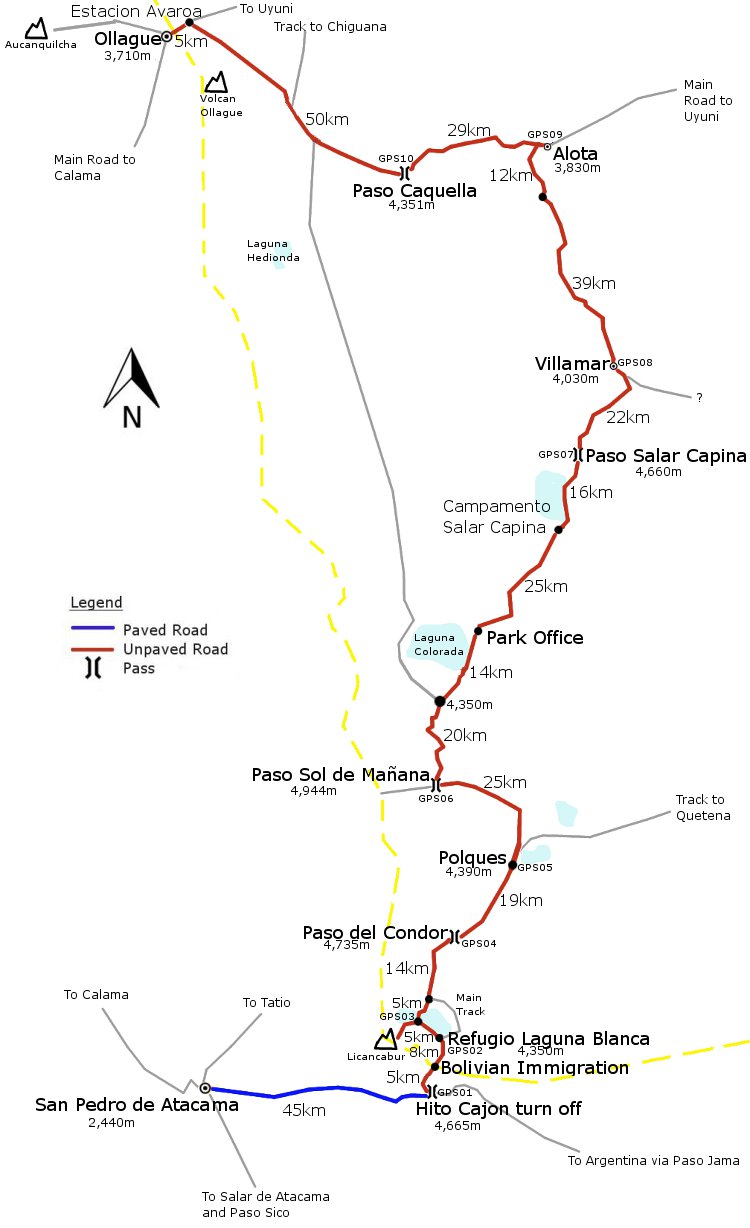
A beautiful trip through the lagunas in southern Bolivia which is a very popular area with cycle tourists and backpackers in jeeps alike. There are a number of routes which can be taken in the Sud Lipez – the one we describe below goes round the west shore of Laguna Blanca (for access to Licancabur), goes northeast from Laguna Colorada to Villamar and Alota, then heads west from Alota to Ollague (for access to Aucanquilcha). The classic route for cyclists is to head north from Laguna Colorada, past Arbol de Piedra and from there north to Laguna Hedionda, San Juan and the Salar de Uyuni, but note that this is also the route almost all the jeeps take. Be prepared for lots of dust.
Like many of the routes described on this website, long sections are at high altitudes and the weather can be extremely cold and windy so ensure you have camping equipment and clothing of sufficient quality to cope with this. High season (May – October) sees plenty of tourist traffic on this route and in these months it is rare to go that long without seeing a jeep.
It’s best to stock up on all supplies before leaving San Pedro (or Ollague/Uyuni if coming from the north). While you can buy some very basic supplies the Bolivian villages on the way, don’t count on finding anything very exciting. The weight of food and the fact you need to carry a day or two of water at times makes for heavy bikes. Added to this, the road surfaces aren’t especially conducive to high speeds, so expect to travel slowly. Not such a bad thing when there are no end of spectacular views to enjoy.
| Total dist. | Stage dist. | Description |
| 0 km | San Pedro de Atacama (2,440m). Tourist town with all facilities, but empty ATMs on Sundays. Do immigration formalities and get water before starting your climb. | |
| 45km | Climb 2,270m to 4,665m on tarmac. Reasonable amount of traffic. No water. | |
| 45km | Hito Cajon turn-off (4,665m – GPS01). Go left. | |
| 5km | Downhill on ripio. | |
| 50km | Bolivian immigration. Water. | |
| 8km | Downhill on ripio for about 6kms to Eduardo Avaroa park office (150Bs entry) then further 2km to the refugio at Laguna Blanca. | |
| 58km | Refugio Laguna Blanca (4,350m – GPS02). Accommodation, water, very basic supplies. From the refugio we went left (clockwise) round Laguna Blanca as we wanted to climb Licancabur. The main road goes right (anti-clockwise) round the lake and is in much the better condition of the two. | |
| 5km | Sandy track to Laguna Verde. After 5kms get to a signposted junction (GPS03) – straight to Licancabur, R to Polques. | |
| DETOUR TO LICANCABUR Go straight at junction GPS03. After about 4kms there are some shelters near Laguna Verde. Possible to hide bikes here, or if it’s not windy, continue on the tough track for a few more kilometers towards the volcano. Just above where the track ends, there are some Inca ruins which provide shelter from the wind and thus make a good base camp from which you can make a day excursion to climb Licancabur. Return to the junction at GPS03 to continue to Polques. | ||
| 63km | Junction GPS03. | |
| 5km | From GPS03 junction, turn north and descend the sandy track for a kilometre to cross the stream between Lagunas Blanca and Verde. There are lots of tracks around, but head northeast and about 4kms from the stream crossing you hit the main ‘road’ again. Again it’s sandy. | |
| 68km | Rejoin the main road which has gone round the east shore of Laguna Blanca. | |
| 14km | Climb to pass. | |
| 82km | Paso del Condor (4,735m – GPS04). | |
| 19km | Descend, then flat to Polques, passing the Piedras de Dali which are to the right of the road. | |
| 101km | Polques (4,390m – GPS05). Possible to stay the night, get food, water and very basic supplies. There are also hot thermals which you will get to yourself in the evening once the jeep tours depart. | |
| 25km | Climb to pass. | |
| 126km | Paso Sol de Mañana (4,944m – GPS06). Turn R at the signposted junction that is the pass. | |
| 20km | Descend to Laguna Colorada. | |
| 146km | Junction at south end of Laguna Colorada (~4,350m). R/straight to Park Office. (L to refugios and the road to Arbol de Piedra and Laguna Hedionda). | |
| 14km | Flat road on E shore of Laguna Colorada. | |
| 160km | Park Office – you’ll be asked to show your park ticket. | |
| 25km | Climb 250m from Laguna Colorada, then descend before 15 flat kilometres to the Salar Capina mining camp. On the flat section the road splits into two and the two run parallel. We went on the left hand road. The roads rejoin again about 8kms before the mining camp. | |
| 185km | Campamento Salar Capina. Possible to stay the night, get a basic meal and water. | |
| 9km | Skirt eastern edge of Salar Capina. At a junction with a signpost (can’t recall what it said), go R (climbing) rather than sticking to the edge of the salar. After a very short climb, road descends to the edge of the Salar briefly before beginning the proper climb to the pass. | |
| 194km | Begin proper climb to the pass. | |
| 7km | Climb to pass. Initially steep but then flattens off. | |
| 201km | Paso Salar Capina – 4,660m (GPS07). | |
| 22km | Descend steeply down a pretty valley. During this descent there is a stream to wade. Go L at a junction 2km before Villamar. | |
| 223km | Villamar (4,030m – GPS08). First proper village since San Pedro de Atacama. Basic shops, 3 hospedajes. For Alota, continue on the road through town. | |
| 39km | Flat with little climbing. | |
| 262km | Start of descent to Alota. | |
| 12km | Descend to Alota. If you stick to the main road you have to wade the river before Alota. As you near Alota it may be better to ignore the desvio signs (they looked like they might stay there a while), follow the ‘closed’ road and cross the river on the foundations of a bridge. Join the main Avaroa to Uyuni road just west of Alota (and go R for the village). | |
| 274km | Villa Alota (3,830m – GPS09). Nice village with plenty of accommodation options and some slightly less basic shops. | |
| 29km | Leave town heading W on main road (go E for the main road to Uyuni). Climb to pass. The first 15kms were on a good surface as good as tarmac. | |
| 303km | Paso Caquella (4,351m – GPS10). | |
| 50km | Small ups and downs for 32kms. From ~4,150m begin 18km descent to Avaroa. | |
| 353km | Estacion Avaroa, the Bolivian border post. It has a train station, immigration facilities and some old abandoned trains, but no shop or accommodation. | |
| 5km | Head west and cross the border to Chile. All flat. Surface looked suspiciously like old tarmac on the Chilean side. | |
| 358km | Ollague (3,710m). Village with guesthouses (Hostal Atahualpa and Hostal El Cuervo offer beds for around 10000pesos per night) which offer meals, 2 free internet places, and a couple of shops in which you will find a better selection of goods than anywhere since leaving San Pedro. Still not much fresh fruit or veg around though. |
| Details | |
| Time taken – 7 days and amount climbed 5,310m | 8 hours: San Pedro – Laguna Blanca (2,300m climb). 8 hours: Laguna Blanca – Laguna Verde (for Licancabur) – Polques (600m climb). 7 hours: Polques – Laguna Colorada (N end) (740m climb). 7 hours: Laguna Colorada – Villamar (610m climb). 4 hours: Villamar – Alota (210m climb). 8 hours: Alota – Ollague (850m climb). |
| Traffic | Plenty on paved road to turn-off to Hito Cajon. Tourist jeeps (very dusty) when on main ‘road’ from Laguna Blanca to Villamar, though only at certain hours of the day. Nothing from Villamar to Alota. Some lorries from Alota to Avaroa. |
| When we cycled | Late June 2010. |
| Difficulty | 4 |
| How much we had to push on this route | None on the main route. A lot on the detour round Laguna Blanca to climb Licancabur. |
| GPS Point | Description | Lat/Long/Altitude |
| GPS01 | Hito Cajon turn-off | 22.9170 S, 67.7966 W, 4,665m. |
| GPS02 | Refugio Laguna Blanca | 22.8220 S, 67.7837 W, 4,350m. |
| GPS03 | Junction | 22.7995 S, 67.8186 W, 4,350m. |
| GPS04 | Paso del Condor | 22.6679 S, 67.7548 W, 4,735m. |
| GPS05 | Polques | 22.5358 S, 67.6498 W, 4,390m. |
| GPS06 | Paso Sol de Mañana | 22.4254 S, 67.7879 W, 4,944m. |
| GPS07 | Paso Salar Capina | 21.8970 S, 67.5422 W, 4,660m. |
| GPS08 | Villamar | 21.7561 S, 67.4813 W, 4,030m. |
| GPS09 | Villa Alota | 21.4030 S, 67.5987 W, 3,830m. |
| GPS10 | Paso Caquella | 21.4455 S, 67.8438 W, 4,351m. |
Here are a few links to good resources about this route/area:
Tour.tk have an excellent guide to Cycling South West Bolivia.
Beat’s betzgi.ch site has good route information for the road from San Pedro de Atacama to the Salar de Uyuni via Laguna Hedionda.
And here are some blog entries we like which cover trips in the region:
Carl’s South America by Bike.
Amaya and Eric’s Worldbiking.info.
The first day of Jeff Kruy’s journal entries on CGOAB.
There are many other journals from trips in this area – please let us know if there are any really good ones that you think we should include here.
Error thrown
Call to undefined function ereg_replace()