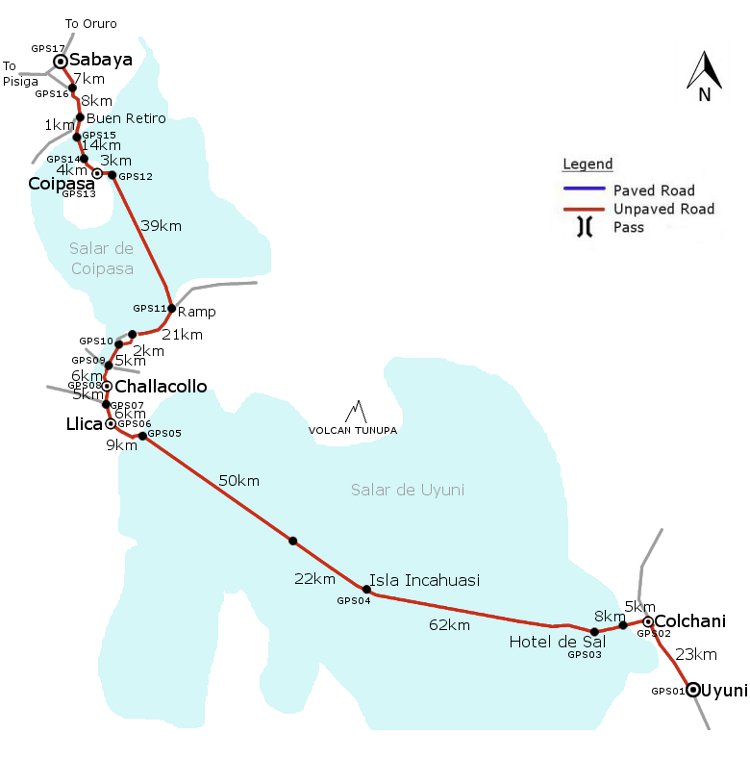
Uyuni to Sabaya

Uyuni – Isla Incahuasi – Llica – Coipasa – Sabaya


An at times surreal trip across Bolivia’s two biggest salars – Uyuni and Coipasa. The larger Salar de Uyuni is great fun to cycle on, but from Colchani to Isla Incahuasi you’ll often have to share it with tourist jeeps. Crossing the Salar de Coipasa was a magical and unforgettable experience – we saw no-one and nothing except sparkly salt for the afternoon it took us to cross to Coipasa island.

Make sure you clean your bike well after crossing the salars. The Salar de Coipasa especially will leave a salt deposit on your bike. Also ensure you wear sunglasses and sun cream – otherwise the strong altiplano sun and reflection off the salars will fry you. If you plan on camping on either salar note that there is absolutely no protection from the wind and also that the salt is very hard so it’s difficult to get tent pegs into it.

It’s also a good idea to check with local people on the current state of each of the salars. In wet season they become inundated and difficult or impossible to cycle on – and the dates this occurs can vary quite a bit year on year.

NextGen ScrollGallery thumbnailNextGen ScrollGallery thumbnailNextGen ScrollGallery thumbnailNextGen ScrollGallery thumbnailNextGen ScrollGallery thumbnailNextGen ScrollGallery thumbnailNextGen ScrollGallery thumbnailNextGen ScrollGallery thumbnailNextGen ScrollGallery thumbnailNextGen ScrollGallery thumbnailNextGen ScrollGallery thumbnailNextGen ScrollGallery thumbnailNextGen ScrollGallery thumbnailNextGen ScrollGallery thumbnailNextGen ScrollGallery thumbnailNextGen ScrollGallery thumbnailNextGen ScrollGallery thumbnail
Heading into a gale on the Salar de Uyuni
Storm on the Salar de Uyuni
Flags at the Hotel de Sal
Salar de Uyuni
Salar de Uyuni
Salar de Uyuni
Isla Incahuasi
Volcan Tunupa from Isla Incahuasi
Salar de Uyuni
Salar de Uyuni
Llica church
Challacollo
North of Challacollo
The edge of the Salar de Coipasa
Salar de Coipasa
Isla de Coipasa
Llamas near Sabaya

Total dist. Stage dist. Description
0km Uyuni (3,650m – GPS01). Tourist town with all facilities, including ATM.
23km Take the main road north out of Uyuni, passing the petrol station.
23km Colchani (GPS02). Town with small shops, some pensiones to have lunch at and 2 hospedajes. Turn L (west) in Colchani at the signposted junction to get to the Salar de Uyuni.
5km Once paved road to the salar.
28km Reach the edge of the Salar de Uyuni.
8km Good, fast surface on jeep track to the Hotel de Sal.
36km Hotel de Sal (GPS03). Water, expensive snacks, meals and accommodation available.
62km Good surface to Isla Incahuasi. Take the R of the 2 tracks that leave the Hotel de Sal towards the island, as this is the most direct route.
98km Isla Incahuasi (GPS04). All the tourists in Bolivia seemed to be there on the W side of the island when we arrived, but they soon left to allow us to enjoy sunset to ourselves. Water and meals are available. Alfredo (the island’s first resident) will let you stay in his ‘cave’ for a fee but you can camp on the island away from the buildings for free. 15Bs entrance fee to go onto the island (a guardaparque cycles round the island to check no-one is trying to sneak on!). For Llica take main track radiating northwest from the island.
22km Good surface towards Llica.
120km Alongside Isla del Pescado, which is a few kilometres to the south.
50km Surface continues to be excellent all the way across the Salar.
170km Exit Salar de Uyuni at (GPS05). Continue taking shortcuts across the Salar though as this is quicker than taking the road round the shore.
9km After 5 kms of shortcuts across the Salar join the road for 4 kms of washboard to Llica.
179km Llica (GPS06). Large village with accommodation, a number of restaurants, shops and decent internet. A brass band marched round the street playing the same tune continuously for the 2 days we stayed.
6km Leave Llica heading north. Washboard and sand, but rideable to the junction.
185km Junction (GPS07). Signposted. Head R towards Tres Cruces.
5km Sandy surface and some short pushes required.
190km Challacollo (GPS08). Small village with a nice church. Didn’t see any shops or inhabitants, but it looked lived in so probably possible to get water.
6km Continue heading NE. Road is still sandy, but if you take short cuts on motorbike tracks the surface is better. 5 kms from Challacollo the surface improves to hard mud.
196km Crossroads (GPS09). Go straight. R heads to a small (abandoned?) village.
5km Good surface on main ‘road’.
201km Junction (GPS10). We went R (very small climb) and this took us to Villa Victoria, where there was a family and we could obtain water. The road was very sandy and we had to push some of the 2kms to the village and back to the main road. Unless you need water, better to go L at the junction.
2km Sandy surface to Villa Victoria (1.3km from junction). A little better for the 0.7 km back to the main road.
203km Rejoin main ‘road’.
21km Continue heading E on an ok track. There were many tracks heading L (north) onto the Salar de Coipasa, but we ignored these, thinking the Salar might be spongy here, and carried on to join the Salar at a ramp. This is a few kms past the village of Tres Cruces (the track we were on did not go to the village, but passed a few kms to the N of it) near the only tree we saw all day. If the salt at the edge of the salar is solid it may well be easiest just to head onto the Salar at the earliest opportunity.
224km Ramp onto Salar de Coipasa (GPS11).
39km Magical cycle on the Salar de Coipasa. No traffic, tracks or rubbish. Nothing but whiteness and sparkly salt. First few hundred metres on the Salar were a bit spongy, but after the surface was good (though not as hard as the Salar de Uyuni, so our bikes got a lot of salt on them). Head for the right hand side of Coipasa island, where there is a small hill.
263km Leave Salar at (GPS12) and go onto Isla de Coipasa.
3km Good track to Coipasa village.
266km Coipasa village (GPS13). Accommodation, water, basic supplies. No restaurant.
19km Leave Coipasa on track heading NW. Some sand and washboard for 4kms until track re-enters the salar (GPS14). Head north-ish across the salt, straight for the shore. After 9kms we hit a dirt track and 5kms later reached land (GPS15). 1km later this track meets a larger road at the small settlement of Buen Retiro.
285km Buen Retiro. Small settlement. Join main road and go R.
8km Surface is ok, though a bit corrugated in places. Pass 2 small villages on the way to the next junction.
293km Junction (GPS16). Main road goes L, but we took a good short cut and went R, heading straight for Sabaya.
7km Good surface to Sabaya.
300km Sabaya (GPS17). Large village with accommodation, plenty of restaurants and shops, but no internet.
Details
Time taken – 4 days and amount climbed – a massive 430m 7 hours: Uyuni – Isla Incahuasi.
6 hours: Isla Incahuasi – Llica (headwind).
8 hours: Llica – Coipasa (headwind).
3 hours: Coipasa – Sabaya.
Traffic Some from Uyuni to Colchani. Plenty of tourist jeeps from Colchani to Isla Incahuasi. Nothing from Isla Incahuasi to near Llica. A few vehicles around Llica, then nothing to Coipasa. Some near Sabaya.
When we cycled Mid July 2010.
Difficulty 2
How much we had to push on this route 0.5kms (sand)

GPS Point Description Lat/Long/Altitude
GPS01 Uyuni 20.4633 S, 66.8235 W, 3,650m.
GPS02 Colchani 20.3025 S, 66.9384 W, 3,660m.
GPS03 Hotel de Sal 20.3308 S, 67.0468 W, 3,660m.
GPS04 Isla Incahuasi 20.2439 S, 67.6239 W, 3,660m.
GPS05 Edge of Salar 19.8797 S, 68.1742 W, 3,660m.
GPS06 Llica 19.8507 S, 68.2485 W, 3,690m..
GPS07 Junction (go R) 19.8039 S, 68.2636 W.
GPS08 Challacollo 19.7661 S, 68.2636 W.
GPS09 Crossroads 19.7164 S, 68.2589 W.
GPS10 Junction 19.6777 S, 68.2392 W.
GPS11 Ramp onto Salar de Coipasa 19.5814 S, 68.0904 W, 3,660m.
GPS12 Enter Isla de Coipasa 19.2776 S, 68.2628 W, 3,660m.
GPS13 Coipasa Village 19.2778 S, 68.2782 W, 3,660m.
GPS14 Re-enter Salar 19.2583 S, 68.3076 W, 3,655m
GPS15 Hit land 19.1462 S, 68.3227 W, 3,660m.
GPS16 Junction (take shortcut R) 19.0763 S, 68.3422 W.
GPS17 Sabaya 19.0160 S, 68.3712 W, 3,700m.


View Uyuni – Sabaya in a larger map
Nearby routes:        Ollague to Uyuni                 Sabaya to Sajama

5 Responses to “Uyuni to Sabaya”

  1. Yoko & Hiro 18/08/2012 at 16:43 # Reply

    Thank you for great information.
    We cycled the Salar de Coipasa on Nov,2011, from Coipasa island to the southern shore of the lake.
    It was very difficult to cycle because the surface was either spongy with water or bumpy with lots of crystals.
    So we also recommend to double-check the current state before entering the lake.

    Have a safe journey!

  2. santiago ramos 25/08/2012 at 21:15 # Reply

    i did the route described above but in reverse. i started from oruro to sabaya spending one night in Corque and one in sabaya. the road from oruro to toledo 45km is paved and flat. then its around 50 km on a dusty corugated road(some climbing but not much)to corque where there is basic acomodation half a block from the plaza and supplies. no internet but if you have a celphone there is entel coverage and should work on gprs or edge. then 20 km to Ancravi on dirt road and then 105 km of paved road to sabaya. the road to the north coipasa shore is as described however it probably better to follow it all the way to villa vitalina since the salt harvesters from this town will let you know the best and dryest route to the island. i had to back track to the salt mine since the flats were 15 cm under water on the east side of the island. mind you the way from vitalina to coipasa is also wet but not as much. in isla coipasa there is an unatended tourist shelter but a man named Urgel Manuel let me stay in his house for free and fed me as well. he lives a block south of the plaza. could not leave the island on the east side so had to circle it all the way to west side along the north shore to a salt harveswting operation. the follow the jeep tracks to try to intersect the rout on your page but had to spend the night on the salt 12km north of the shore as camping on the shore was probably more dangerous. magical night of absolute solitude. btw wind dies down after sun down so wind chill is not much of an issue but dont atempt if you dont have good camping gear.the ramp you described is unreachable if the salar is wet and is probably better to head straight to villa victoria. in fact i saw 6 or 7 jeeps take this route an then you probably avoid all the flooded plains and most importantly 20+ km of horrible sand and solitude. it makes no sense to head to the ramp. either in the coipasa island harvest or in chacollo you cas ask for directions and surely there are tire track on that route. make sure you are well stalked with water since there is no one to aide you befor 6 pm on any of the towns on the shore. llica is a biggish town and acomodation is available in the gobernacion. acrtos the street above the internet place but i suggest you avoid this place since the owner of this alojamiento is in lack o a better word a huge gaping asshole with a reputation around town for overcharging travelers. there is another hotel belonging to señor angel on the main plaza.. the rest of the route to incahuasi and colchani is very nice and easy and in incahuasi they charge 30bol to hike the island and 30 to stay at the shelter. they dont allow alfredo and his wife to host people anymore.
    thx harriet and safe travels

  3. Eric 26/08/2012 at 20:18 # Reply

    When we cycled : mid-august 2012
    From Sabaya to Llica

    Leaving Sabaya, the main track is easy to find just out of the west side of the town
    It leads straight to Villa Vitalina, where locals told us the Salar was too spongy to cycled on, which was probably not true.
    Anyway, we carried on to the next pueblo where a well used track goes from north to south across the Salar between the Island and the Chilean Border. We took shortcuts and the northern area was spongy, better to stay on the track, then it get hard but really bumpy and only the southern area is hard, flat and fast.
    Then the track follows the edge of the Salar to avoid the spongy southern area and it fnally joins the main track to Challacollo and Llica.

    The last 25km before Llica are a nightmare of unavoidable washboard and sand.

    Llica : We found pollo con papas fritas (but only in the evening) !
    Accomodation : there is one alojamiento that did not want our bikes in. They directed us to the Alcaldia which also has (very simple) rooms but hot shower (common) for 20 bolivianos each

  4. Eric 11/09/2012 at 01:03 # Reply

    We cycled from Llica to Isla grande (20km west of Incahuasi), then San Pedro de Quemez.
    Date : august 2012

    We did not take the jeep tracks across the Salarto go straight to Isla Grande. It was dry, but incredibly bumpy. We averaged 12km/h, impossible to go faster.
    We slept on Isla Grande, really nice “beach” on the eastern side. Should be possible to hide if the wind is really strong.
    From Isla Grande, it took us one day and a half to San Pedro de Quemez (Quemez on some maps). Salar still bumpy and the track on the western shore of the peninsula can be sandy. There is one alojamiento (25 blvs each) and one fancy hotel for the tourists with jeeps. We could stock up on food for the Ruta de las Lagunas : pasta, avena, flour, even potatoes, oignon and manzana if you are lucky. Salchipapa and papas fritas for dinner :)

    For those going south through ruta de las Lagunas and using the tour.tk well reknown pdf tour guide, have look in the comments here for our update (the road conditions are not up to date anymore) :

    http://www.tour.tk/tour-guides-south-west-bolivia.htm

    Thanks a lot to Andes by bike for this really good website !! May be we will cycle another route one day !

  5. Alvaro Reyes 29/10/2012 at 19:34 # Reply

    We cycled this route in August 2012. We were going south, and had some big problems crossing Coipasa because it was covered in water.

    The locals directed us to a track which goes from the west side of Isla Coipasa, and skirts along close to the western shore of Lago Coipasa. The tracks are hard to follow, perhaps we took the wrong one, but it is very difficult to access point GPS11 if taking this route to cross Coipasa, as we ended up in spongy hell as we were off the main track.

    If you are forced to cross on the west side, check out Jeff Kruys’ blog, as he has some GPS points which can help guide you.
    http://www.crazyguyonabike.com/doc/page/?o=1&page_id=76519&v=2YX

Leave a Reply